Mastering your retrieve is the secret weapon of professional anglers. If you have ever wondered why your buddy is catching more bass while using the same lure, the answer often lies in the mechanics of their reel. Understanding fishing reel gear ratio is the difference between a sluggish retrieve and a strike-inducing presentation. Whether you are burning topwater lures or finessing deep-diving crankbaits, choosing the right speed is paramount. In this guide, we break down everything you need to know about gear ratios to ensure your 2026 fishing season is your most successful one yet.
What Does Gear Ratio Mean in Fishing Reels?
At its simplest, a fishing reel gear ratio represents how many times the spool rotates for every single turn of the reel handle. A ratio of 6.4:1 means the spool rotates 6.4 times for one full crank of the handle. This number dictates your retrieval speed, torque, and how much effort you need to exert to pull a fish out of heavy cover.
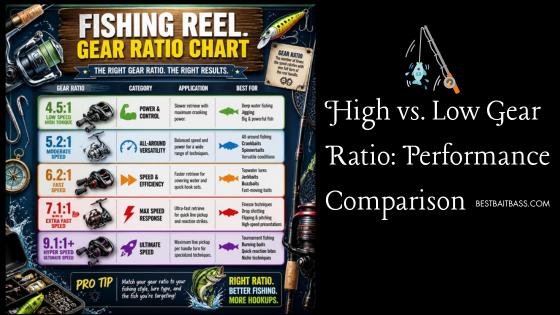
Understanding the Fishing Reel Gear Ratio Chart
To simplify things, refer to this basic classification:
1. Low Gear (4.0:1 to 5.4:1): High torque, lower speed. These provide more torque and are often referred to as “power” gears. They require less effort to reel in heavy baits or fight against the resistance of deep-diving lures.
2. Mid Gear (5.5:1 to 6.4:1): Versatile, all-purpose speed. These are the “all-purpose” workhorses. They provide a versatile balance between speed and control.
3. High Gear (7.0:1 to 10.1:1): High speed, lower torque. These are speed demons, allowing you to take up slack line instantly or bring lures back to the boat quickly for repeated casts.
How to Choose the Right Fishing Reel Gear Ratio
When selecting your setup, ask yourself: What lure am I throwing? The resistance of the bait in the water should dictate your choice. High-drag lures like deep-diving crankbaits require lower gear ratios to prevent angler fatigue, while reaction baits like jigs or topwaters benefit from the high-speed pickup of faster reels.
Low Gear Ratio Reels: Power and Control
Low gear ratio reels are your workhorses. They offer significant mechanical advantage, making them the best fishing reel gear ratio for lures that create high resistance. These reels allow you to maintain a slow, steady, and methodical retrieve, which is crucial when fishing in cold water or when bass are lethargic.
High Gear Ratio Reels: Speed and Efficiency
Fast gear ratio reels are essential for techniques requiring a quick line pickup. If you are fishing topwater baits, a high gear ratio allows you to eliminate slack instantly after a missed blowup or to quickly pull a fish away from thick vegetation. They are also indispensable for “burning” spinnerbaits over grass beds.
Expert Advice: Best Gear Ratios for Common Techniques
* Deep Crankbaits: 5.4:1 to 6.2:1 (Reduces torque and fatigue)
* Topwater Fishing: 7.5:1 to 8.5:1 (Quick line management)
* Jigs & Texas Rigs: 7.1:1 to 7.5:1 (Fast slack removal)
* Spinnerbaits: 6.4:1 to 7.1:1 (Versatile speed)
By matching your gear ratio to your specific technique, you increase your efficiency on the water and your overall strike conversion rate. Always consider the cover, the water temperature, and the specific lure action when selecting your next reel.
Conclusion
Mastering your understanding of gear ratios transforms how you interact with your lures and your targets. Remember that there is no single “best” ratio, but rather the right ratio for the job at hand. Start by building your collection with a versatile 7.1:1 reel for general tasks, and slowly expand into specialized low-gear reels for crankbaits and high-gear reels for precision work. By matching your equipment to your technique, you ensure that you are always in total control of your presentation, leading to more bites and more fish in the boat.