For decades, the Texas rig has reigned supreme as the undisputed king of heavy cover bass fishing. If you wanted to pull a big largemouth out of a dense mat of milfoil, a tangled laydown, or a chaotic pile of brush, you rigged up a worm or creature bait with a sliding bullet weight and pitched it in. But bass fishing is an evolving sport, and a new contender has emerged from the Japanese tackle scene to challenge this long-held status quo: the Tokyo rig.
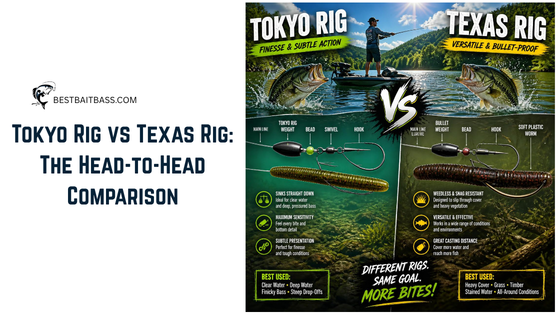
Initially dismissed by some as a passing gimmick, the Tokyo rig has quickly proven itself to be a devastatingly effective weapon. By separating the weight from the bait and placing it on a rigid wire dropper below the hook, this innovative setup solves many of modern angling’s biggest headaches in thick vegetation and nasty structure. In this guide, we will break down exactly why this presentation is revolutionizing the industry, how it stacks up against the classic Texas rig, and how you can master its deployment on your local waterways.
Understanding the Anatomy of the Tokyo Rig
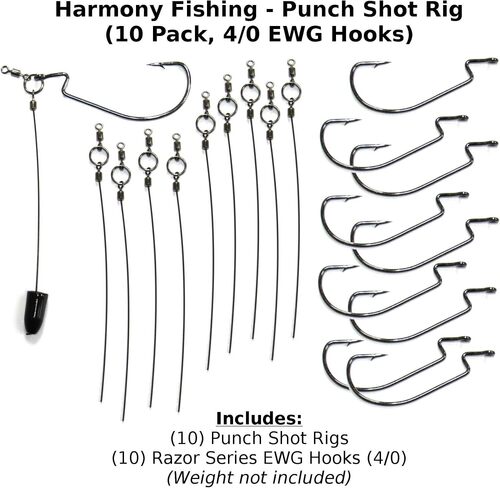
To appreciate why the Tokyo rig has taken the bass fishing world by storm, one must first look closely at its unique physical design. Unlike traditional rigs where the hook, weight, and line run on a single linear path, the Tokyo rig uses a specialized hub-and-spoke system. It starts with a solid, welded ring. Attached to this ring is a heavy-duty wide gap hook, a premium barrel swivel for your main line, and a rigid, customizable wire dropper arm that hangs directly below.
The Wire Dropper Advantage
The wire dropper is the secret sauce of the Tokyo rig. Because the weights are slid onto this rigid wire arm rather than the line itself, the soft plastic bait is suspended slightly off the bottom. This prevents the bait from being buried in silt, muck, or decaying vegetation, keeping it highly visible to foraging bass. Furthermore, the wire can be bent at the bottom to secure your choice of weight, allowing you to quickly swap out quarter-ounce tungsten weights for heavy two-ounce punching weights without ever having to re-tie your knot.
Hook and Swivel Mechanics
The addition of a high-quality barrel swivel at the connection point is another crucial mechanical benefit. When dragging a Texas rig through thick brush, line twist is an inevitable nuisance that can weaken your line and cause frustrating backlashes. The Tokyo rig’s swivel allows the entire setup to spin freely during the cast, retrieve, and battle. Additionally, because the hook is connected to a free-swinging welded ring, the bait has an incredible 360-degree range of motion that no fixed-weight rig can match.
Tokyo Rig vs Texas Rig: The Head-to-Head Comparison
When evaluating the tokyo rig vs texas rig, it is helpful to look at how each setup handles the harsh realities of heavy cover bass fishing. While the Texas rig is incredibly streamlined and weedless, it suffers from a major design flaw: when a bass strikes, the sliding bullet weight can wedge itself in the fish’s mouth, occasionally preventing a clean hook penetration. Additionally, as a Texas rig settles onto a muddy bottom, the weight often pulls the entire bait down into the debris, hiding it from view.
The Tokyo rig completely flips this dynamic. With the weight positioned several inches below the bait on a rigid wire, the soft plastic remains clean, suspended, and highly active. When a bass inhales the bait, the weight drops away instantly, leaving only the hook and the soft plastic in the fish’s mouth. This dramatically increases your hookup-to-land ratio, especially when targeting pressured bass in thick cover.
| Feature / Performance Metric | Tokyo Rig | Texas Rig |
|---|---|---|
| Bait Action & Mobility | Maximum (360-degree free-swinging) | Restricted (pinned in-line with weight) |
| Weedless Efficiency | High (slips through vertical cover) | Very High (highly streamlined profile) |
| Silt/Debris Mitigation | Superior (suspends bait above muck) | Poor (drags bait down into silt) |
| Hookup Ratio | Excellent (direct upward hook leverage) | Good (weight can interfere with hookset) |
| Weight Customization | Instant (no re-tying required) | Slow (must re-tie or slide pegs) |
| Best Suited For | Punching mats, hard bottoms, sparse grass | Extremely tight brush, heavy wood laydowns |
Vertical Presentation vs. Sliding Weights
The primary functional difference between these two rigs lies in how they descend through the water column. A Texas rig falls in a nose-first, gliding motion. While this is great for slipping through branches, it restricts the natural secondary action of creature baits. The Tokyo rig, by contrast, drops straight down like a plumb bob. The weight hits the bottom first, and the bait slowly flutters down behind it, mimicking an injured baitfish or crawfish with unmatched realism.
Hookup Ratio and Leverage
Another critical aspect is leverage during the hookset. When you set the hook on a Texas rig, you must pull both the weight and the hook through the fish’s jaw. If the bullet weight is pegged, it can act as a fulcrum, allowing the bass to shake its head and throw the hook. The Tokyo rig eliminates this issue. Because the hook swings freely on a split ring, the bass cannot use the weight’s mass as leverage to spit the hook, resulting in more fish in the livewell.
How to Fish a Tokyo Rig in Heavy Cover
Mastering how to fish a tokyo rig requires a slight shift in mindset from traditional worm-fishing techniques. Because of the rig’s unique action, you do not need to constantly hop or drag it to create movement. Even when held perfectly still, the subtle underwater currents will cause your soft plastic to quiver and dance on its free-swinging ring.
Punching and Flipping Mats
When targeting dense mats of vegetation, use a heavy tungsten weight (or even two weights stacked back-to-back on the wire arm) to break through the canopy. Pitch the rig high and let it crash through the mat. Once it penetrates, let it settle to the bottom. Instead of immediately lifting it, gently shake your rod tip on a semi-slack line. This transmits a highly enticing shivering motion to the bait while keeping the weight pinned to the bottom.
Crawling Through Wood and Rock
The rigid wire of the Tokyo rig acts as a high-performance feeler when fished around hard structures like submerged roadbeds, rock piles, and standing timber. As you drag the rig, the wire transmits vibrations directly up your braided line, giving you an accurate picture of the bottom composition. When the wire bumps over a rock or log, the bait hops up and over the obstruction safely, virtually eliminating costly snags.
Choosing the Right Soft Plastics
Because the Tokyo rig maximizes bait action, you want to pair it with soft plastics that have built-in movement. Flapping craws, creature baits with curly appendages, and small paddle-tail swimbaits are all exceptional choices. Since the bait rides above the bottom, choosing high-buoyancy plastics can further enhance the presentation, making your bait look like a defensive crawfish standing its ground.
Optimizing Your Gear for Heavy Cover Bass Fishing
To successfully pull big bass out of the thickest cover using a Tokyo rig, you cannot afford any weak links in your tackle system. The direct vertical hooksets and brutal fights characteristic of heavy cover bass fishing demand specialized, heavy-duty gear.
The Ideal Rod and Reel Setup
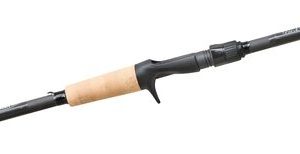
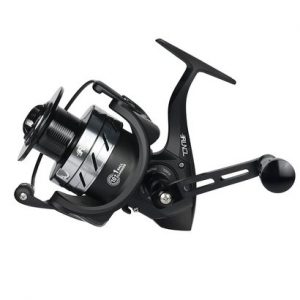
You will want to opt for a casting rod measuring at least 7’3″ to 7’6″ with a Heavy or Extra-Heavy action and a fast tip. This length and power are essential for steering hooked fish out of dense vegetation before they can wrap you up. Pair this rod with a high-speed baitcasting reel (7.3:1 gear ratio or faster). A fast reel allows you to quickly pick up slack line and crank fish to the surface before they realize what hit them.
Line Selection: Braided vs. Fluorocarbon
For almost all punching and heavy grass scenarios, 50 to 65-pound test braided line is non-negotiable. Braided line cuts through aquatic vegetation like a saw blade, ensuring you can pull both the bass and five pounds of salad back to the boat. However, if you are fishing extremely clear water or targeting jagged rocks and wood where braid might fray, a heavy 17 to 20-pound test fluorocarbon leader or main line is the superior choice due to its high abrasion resistance and low visibility.
Conclusion
The Tokyo rig represents a true paradigm shift in modern bass angling, successfully bridging the gap between the weedless efficiency of the Texas rig and the erratic, free-swinging action of a dropshot. By isolating the weight on a rigid wire dropper, it provides superior bait visibility, unmatched hookup ratios, and incredible adaptability in the nastiest cover imaginable.
While the classic Texas rig will always have a valued place in your tackle box, integrating the Tokyo rig into your heavy cover arsenal will undoubtedly help you catch more fish. The next time you find yourself staring at an impenetrable mat of vegetation or a gnarly laydown, don’t default to the old ways. Tie on a Tokyo rig, drop it deep into the strike zone, and experience the revolution for yourself.